---
pretty_name: SimWorld Unreal Backend (Binary + Paks)
license: apache-2.0
language:
- en
tags:
- simulation
- unreal-engine
- binaries
- paks
- robotics
- multimodal
- agents
task_categories:
- other
size_categories:
- n<1K
---
# SimWorld: An Open-ended Realistic Simulator for Autonomous Agents in Physical and Social Worlds

**SimWorld** is a simulation platform for developing and evaluating **LLM/VLM** AI agents in complex physical and social environments.
## 🔥 News
- 2025.11 The white paper of **SimWorld** is available on arxiv!
- 2025.9 **SimWorld** has been accepted to NeurIPS 2025 main track as a **spotlight** paper! 🎉
- 2025.6 The first formal release of **SimWorld** has been published! 🚀
- 2025.3 Our demo of **SimWorld** has been accepted by CVPR 2025 Demonstration Track! 🎉
## 💡 Introduction
SimWorld is built on Unreal Engine 5 and offers core capabilities to meet the needs of modern agent development. It provides:
- Realistic, open-ended world simulation with accurate physics and language-based procedural generation.
- Rich interface for LLM/VLM agents, supporting multi-modal perception and natural language actions.
- Diverse and customizable physical and social reasoning scenarios, enabling systematic training and evaluation of complex agent behaviors like navigation, planning, and strategic cooperation.
## 🏗️ Architecture

**SimWorld** consists of three layers:
- the Unreal Engine Backend, providing diverse and open-ended environments, rich assets and realistic physics simulation;
- the Environment layer, supporting procedural city generation, language-driven scene editing, gym-like APIs for LLM/VLM agents and traffic simulation;
- the Agent layer, enabling LLM/VLM agents to reason over multimodal observations and history while executing actions via a local action planner.
SimWorld's architecture is designed to be modular and flexible, supporting an array of functionalities such as dynamic world generation, agent control, and performance benchmarking. The components are seamlessly integrated to provide a robust platform for **Embodied AI** and **Agents** research and applications.
### Project Structure
```bash
simworld/ # Python package
local_planner/ # Local action planner component
agent/ # Agent system
assets_rp/ # Live editor component for retrieval and re-placing
citygen/ # City layout procedural generator
communicator/ # Core component to connect Unreal Engine
config/ # Configuration loader and default config file
llm/ # Basic llm class
map/ # Basic map class and waypoint system
traffic/ # Traffic system
utils/ # Utility functions
data/ # Default data files, e.g., object categories
weather/ # Weather system
data/ # Necessary input data
config/ # Example configuration file and user configuration file
examples/ # Examples of usage, such as layout generation and traffic simulation
docs/ # Documentation source files
README.md
```
## Setup
### Installation
+ Python Client
Make sure to use Python 3.10 or later.
```bash
git clone https://github.com/SimWorld-AI/SimWorld.git
cd SimWorld
conda create -n simworld python=3.10
conda activate simworld
pip install -e .
```
+ UE server
Download the SimWorld server executable from huggingface. Choose the version according to your OS and the edition you want to use.
We offer two versions of the SimWorld UE package: the base version, which comes with an empty map, and the additional environments version, which provides extra pre-defined environments for more diverse simulation scenarios. Both versions include all the core features of SimWorld.
| Platform | Package | Scenes/Maps Included | Download | Notes |
| --- | --- | --- | --- | --- |
| Windows | Base | Empty map for procedural generation | [Download](https://huggingface.co/datasets/SimWorld-AI/SimWorld/resolve/main/Base/Windows.zip) | Full agent features; smaller download. |
| Linux | Base | Empty map for procedural generation | [Download](https://huggingface.co/datasets/SimWorld-AI/SimWorld/resolve/main/Base/Linux.zip) | Full agent features; smaller download. |
Additional environment paks are available on the [environments paks page](https://huggingface.co/datasets/SimWorld-AI/SimWorld/tree/main/AdditionEnvironmentPaks). You may download them as needed according to the OS you are using.
**Note:**
1. Please check the [documentation](https://simworld.readthedocs.io/en/latest/getting_started/additional_environments.html#usage) for usage instructions of the **100+ Maps** version.
2. If you only need core functionality for development or testing, use **Base**. If you want richer demonstrations and more scenes, use the **Additional Environments (100+ Maps)**.
### Quick Start
We provide several examples of code in `examples/`, showcasing how to use the basic functionalities of SimWorld, including city layout generation, traffic simulation, asset retrieval, and activity-to-actions. Please follow the examples to see how SimWorld works.
#### Configuration
SimWorld uses YAML-formatted configuration files for system settings. The default configuration files are located in the `simworld/config` directory while user configurations are placed in the `config` directory.
- `simworld/config/default.yaml` serves as the default configuration file.
- `config/example.yaml` is provided as a template for custom configurations.
Users can switch between different configurations by specifying a custom configuration file path through the `Config` class.
To set up your own configuration:
1. Create your custom configuration by copying the example template:
```bash
cp config/example.yaml config/your_config.yaml
```
2. Modify the configuration values in `your_config.yaml` according to your needs.
3. Load your custom configuration in your code:
```python
from simworld.config import Config
config = Config('path/to/your_config') # use absolute path here
```
#### Agent Action Space
SimWorld provides a comprehensive action space for pedestrians, vehicles and robots (e.g., move forward, sit down, pick up). For more details, see [actions](https://simworld.readthedocs.io/en/latest/components/ue_detail.html#actions) and `examples/ue_command.ipynb`.
#### Using the Camera
SimWorld supports a variety of sensors, including RGB images, segmentation maps, and depth images. For more details, please refer to the [sensors](https://simworld.readthedocs.io/en/latest/components/ue_detail.html#sensors) and the example script `examples/camera.ipynb`.
#### Commonly Used APIs
All APIs are located in `simworld/communicator`. Some of the most commonly used ones are listed below:
- `communicator.get_camera_observation`
- `communicator.spawn_object`
- `communicator.spawn_agent`
- `communicator.generate_world`
- `communicator.clear_env`
#### Simple Running Example
Once the SimWorld UE5 environment is running, you can connect from Python and control an in-world humanoid agent in just a few lines:
(The whole example of minimal demo is shown in `examples/gym_interface_demo.ipynb`)
```python
from simworld.communicator.unrealcv import UnrealCV
from simworld.communicator.communicator import Communicator
from simworld.agent.humanoid import Humanoid
from simworld.utils.vector import Vector
from simworld.llm.base_llm import BaseLLM
from simworld.local_planner.local_planner import LocalPlanner
from simworld.llm.a2a_llm import A2ALLM
class Agent:
def __init__(self, goal):
self.goal = goal
self.llm = BaseLLM("gpt-4o")
self.system_prompt = f"You are an intelligent agent in a 3D world. Your goal is to: {self.goal}."
def action(self, obs):
prompt = f"{self.system_prompt}\n You are currently at: {obs}\nWhat is your next action?"
action = self.llm.generate_text(system_prompt=self.system_prompt, user_prompt=prompt)
return action
class Environment:
def __init__(self, comm: Communicator):
self.comm = comm
self.agent: Humanoid | None = None
self.action_planner = None
self.agent_name: str | None = None
self.target: Vector | None = None
self.action_planner_llm = A2ALLM(model_name="gpt-4o-mini")
def reset(self):
"""Clear the UE scene and (re)spawn the humanoid and target."""
# Clear spawned objects
self.comm.clear_env()
# Blueprint path for the humanoid agent to spawn in the UE level
agent_bp = "/Game/TrafficSystem/Pedestrian/Base_User_Agent.Base_User_Agent_C"
# Initial spawn position and facing direction for the humanoid (2D)
spawn_location, spawn_forward = Vector(0, 0), Vector(0, 1)
self.agent = Humanoid(spawn_location, spawn_forward)
self.action_planner = LocalPlanner(agent=self.agent, model=self.action_planner_llm, rule_based=False)
# Spawn the humanoid agent in the Unreal world
self.comm.spawn_agent(self.agent, name=None, model_path=agent_bp, type="humanoid")
# Define a target position the agent is encouraged to move toward (example value)
self.target = Vector(1000, 0)
# Return initial observation (optional, but RL-style)
observation = self.comm.get_camera_observation(self.agent.camera_id, "lit")
return observation
def step(self, action):
"""Use action planner to execute the given action."""
# Parse the action text and map it to the action space
primitive_actions = self.action_planner.parse(action)
self.action_planner.execute(primitive_actions)
# Get current location from UE (x, y, z) and convert to 2D Vector
location = Vector(*self.comm.unrealcv.get_location(self.agent)[:2])
# Camera observation for RL
observation = self.comm.get_camera_observation(self.agent.camera_id, "lit")
# Reward: negative Euclidean distance in 2D plane
reward = -location.distance(self.target)
return observation, reward
if __name__ == "__main__":
# Connect to the running Unreal Engine instance via UnrealCV
ucv = UnrealCV()
comm = Communicator(ucv)
# Create the environment wrapper
agent = Agent(goal='Go to (1700, -1700) and pick up GEN_BP_Box_1_C.')
env = Environment(comm)
obs = env.reset()
# Roll out a short trajectory
for _ in range(100):
action = agent.action(obs)
obs, reward = env.step(action)
print(f"obs: {obs}, reward: {reward}")
# Plug this into your RL loop / logging as needed
```
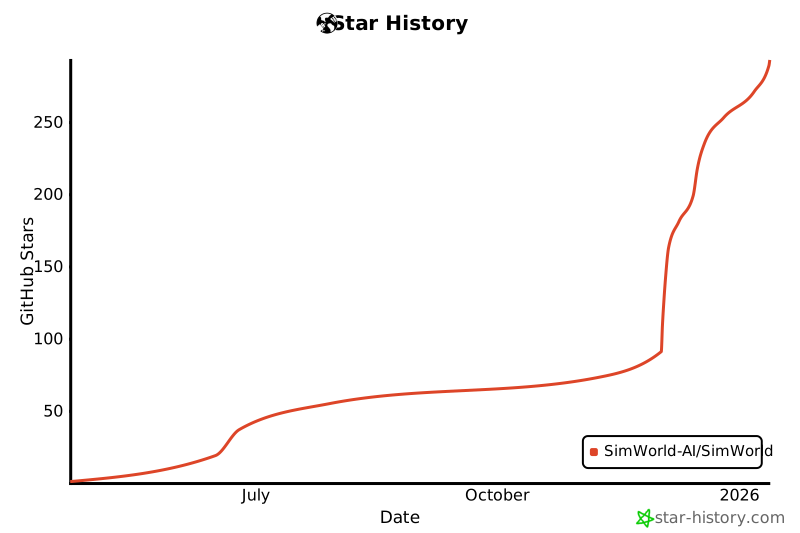
## Star History
[](https://www.star-history.com/#SimWorld-AI/SimWorld&type=date&legend=bottom-right)



