

SauerkrautLM-Vision-Document-Retrieval
Collection
7 items
•
Updated
•
8

⚡ Turbo Edition | 23% Smaller, 88.89 ViDoRe v1
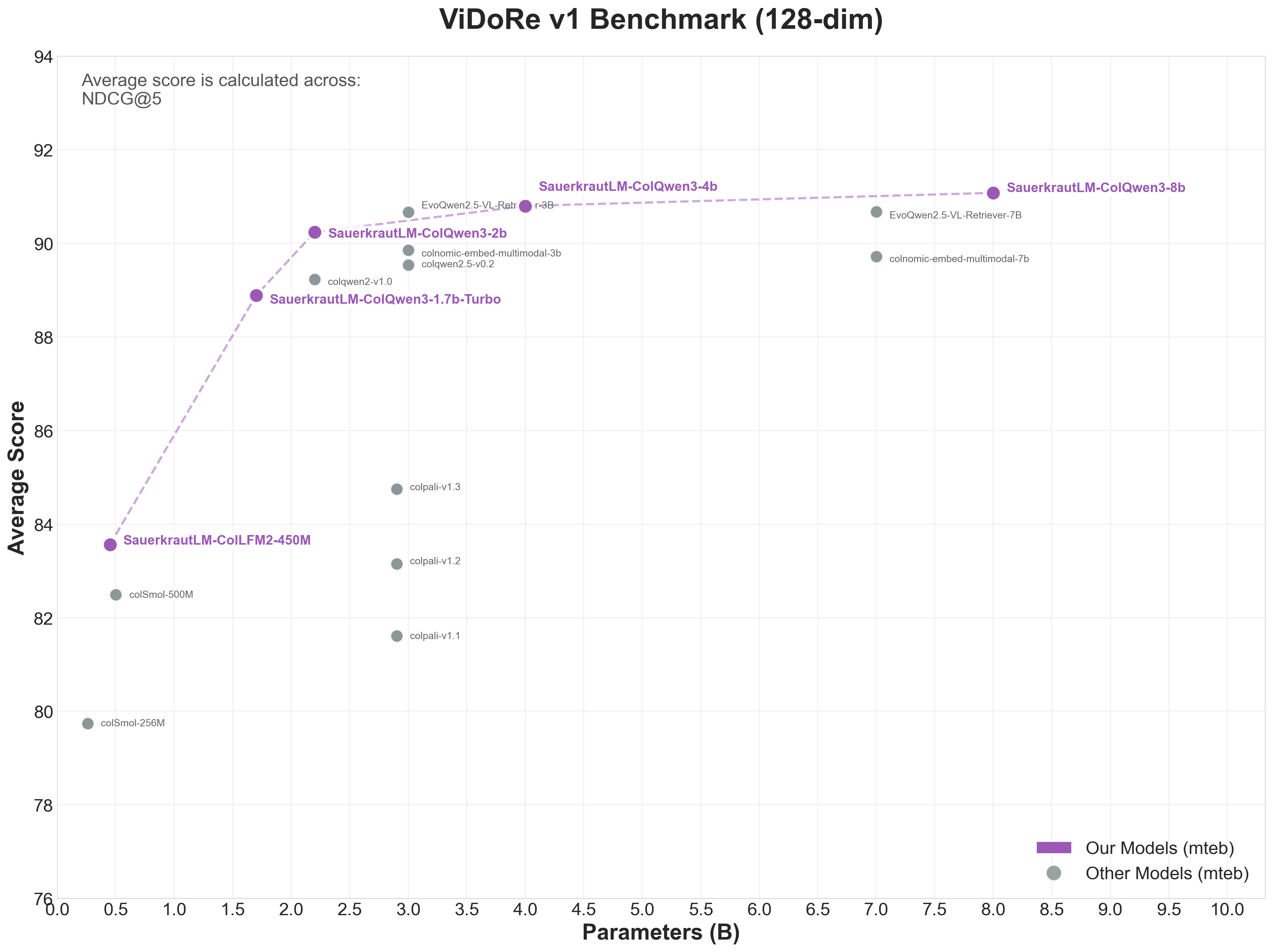
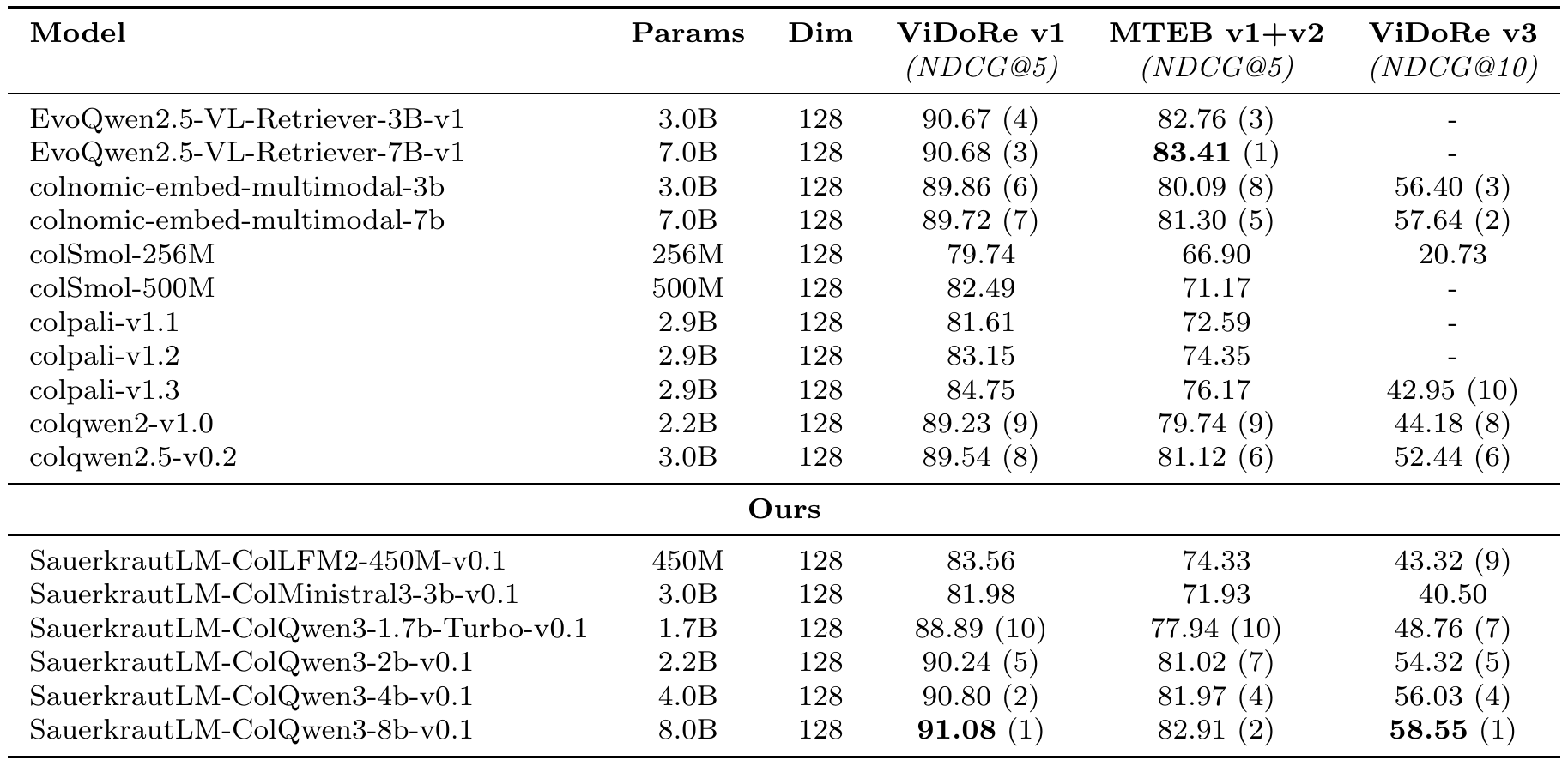
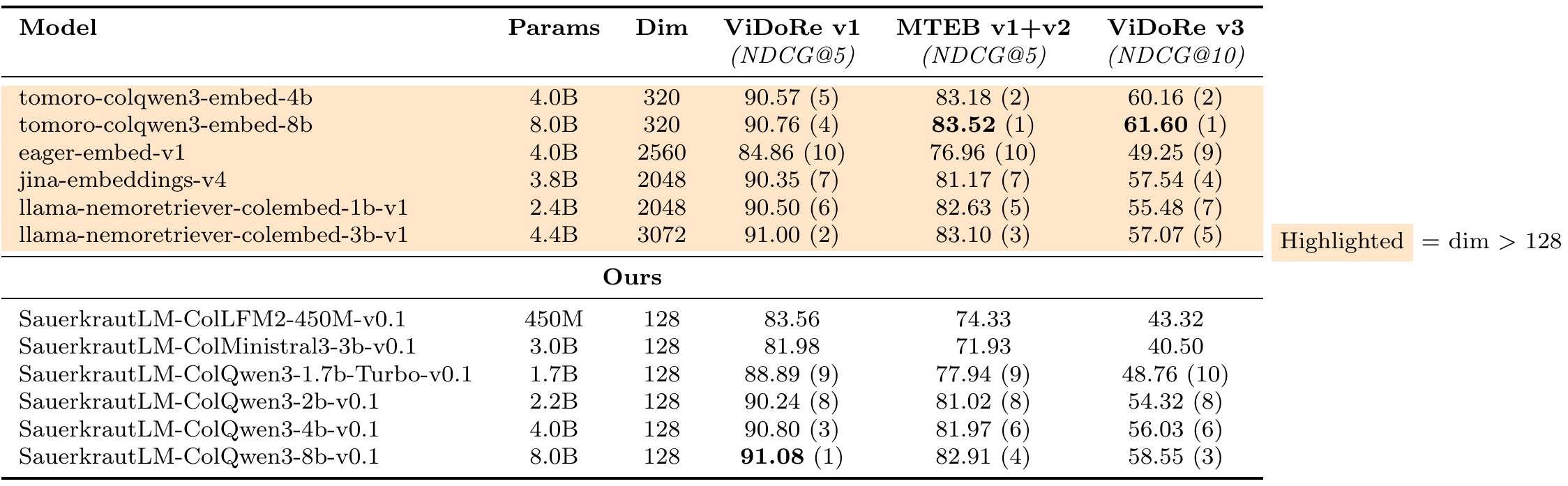
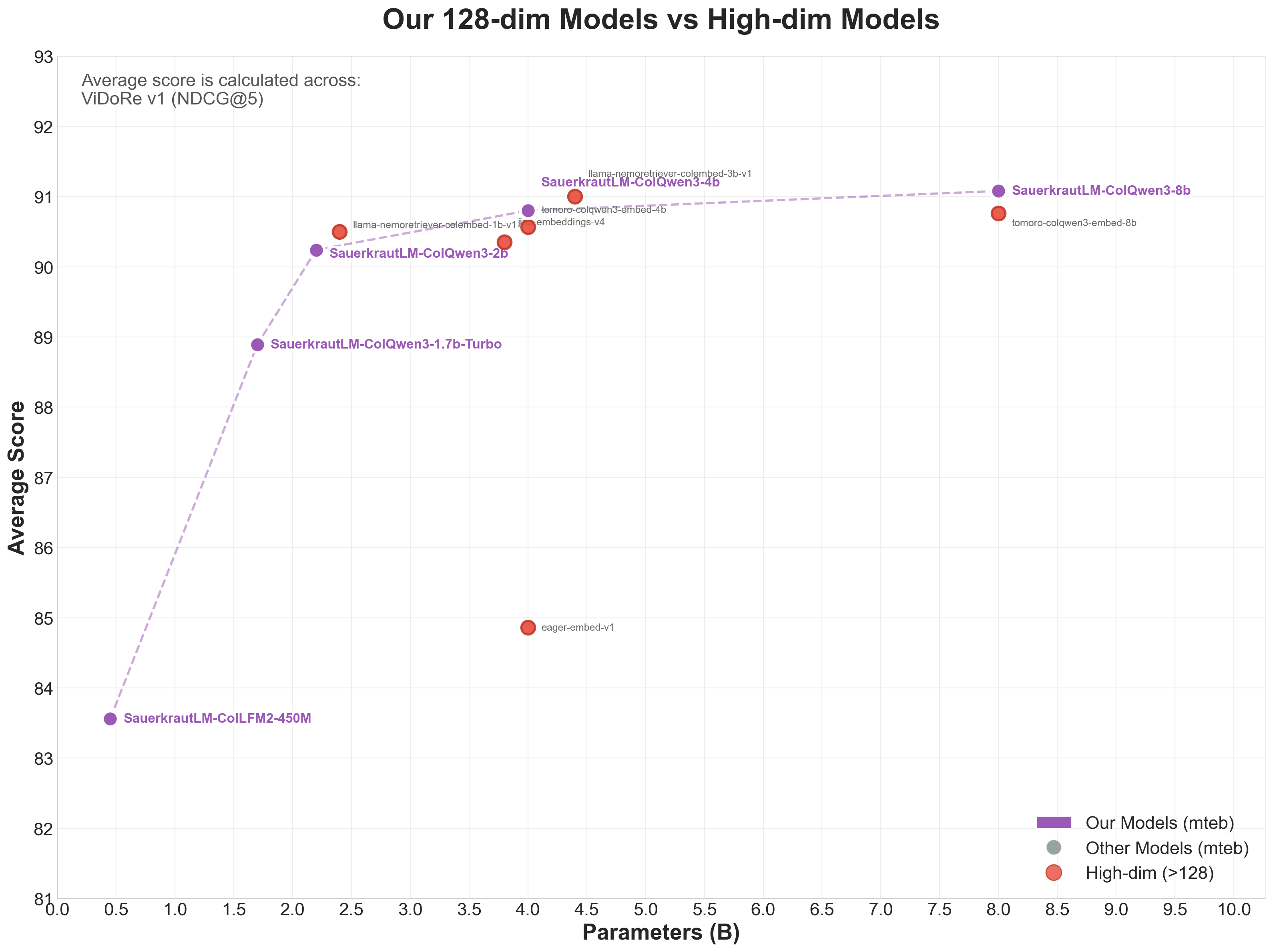
SauerkrautLM-ColQwen3-1.7b-Turbo-v0.1 is a pruned and optimized model created by applying structured pruning to Qwen3-VL-2B. Despite being 23% smaller, it achieves 88.89 NDCG@5 on ViDoRe v1 - still beating ColPali-v1.3 (84.75) by a large margin!
Traditional OCR-based retrieval loses layout, tables, and visual context. Our visual approach:
| Aspect | 2B Model | 1.7B Turbo | Reduction |
|---|---|---|---|
| Parameters | 2.2B | 1.7B | -23% |
| VRAM (bf16) | ~4.4 GB | ~3.4 GB | -23% |
| ViDoRe v1 | 90.24 | 88.89 | -1.35 pts |
| Inference Speed | Baseline | ~20% faster | ⚡ |
| Benchmark | Score | Rank (128-dim) |
|---|---|---|
| ViDoRe v1 | 88.89 | #10 |
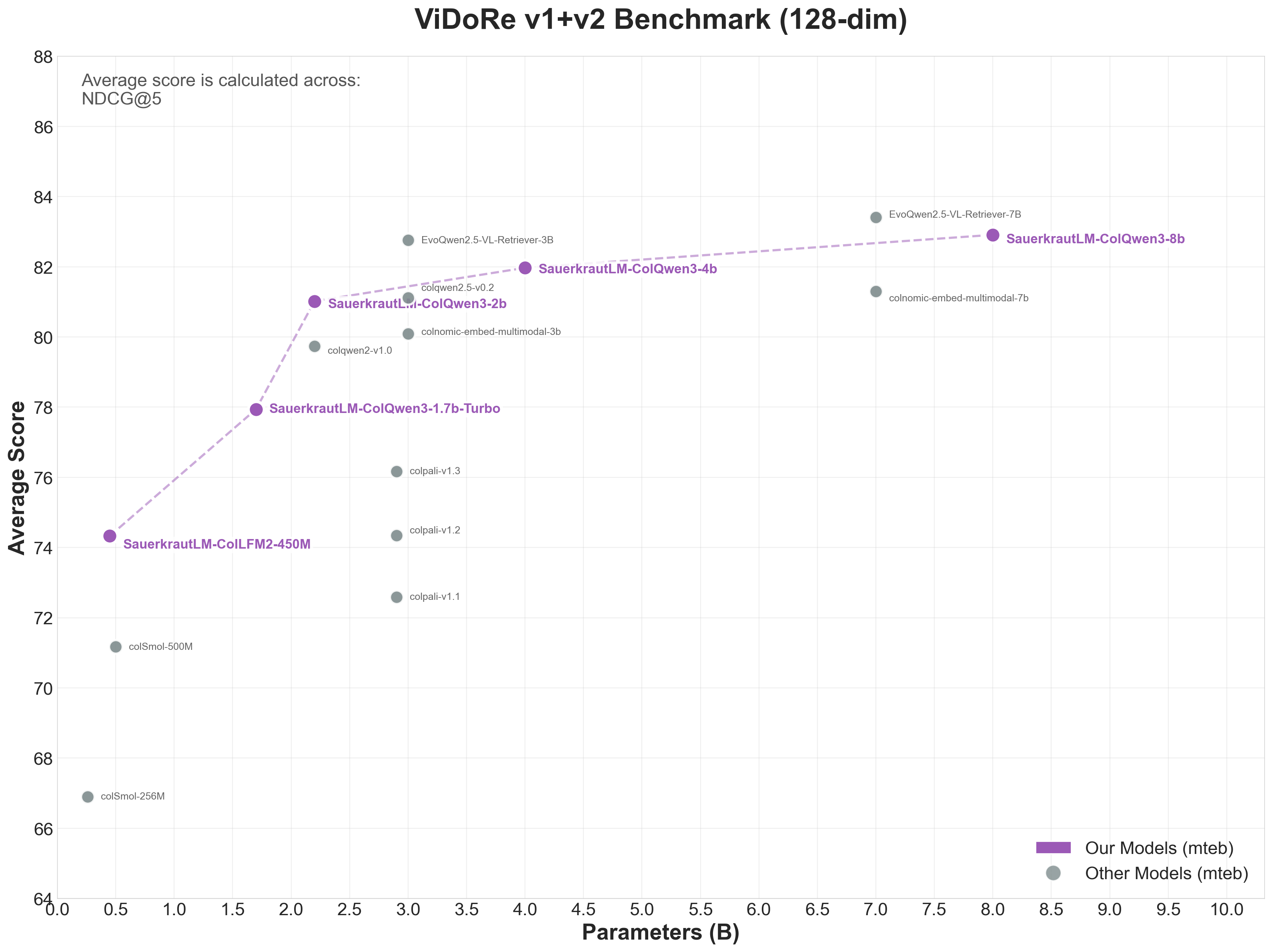
| MTEB v1+v2 | 77.94 | #10 |
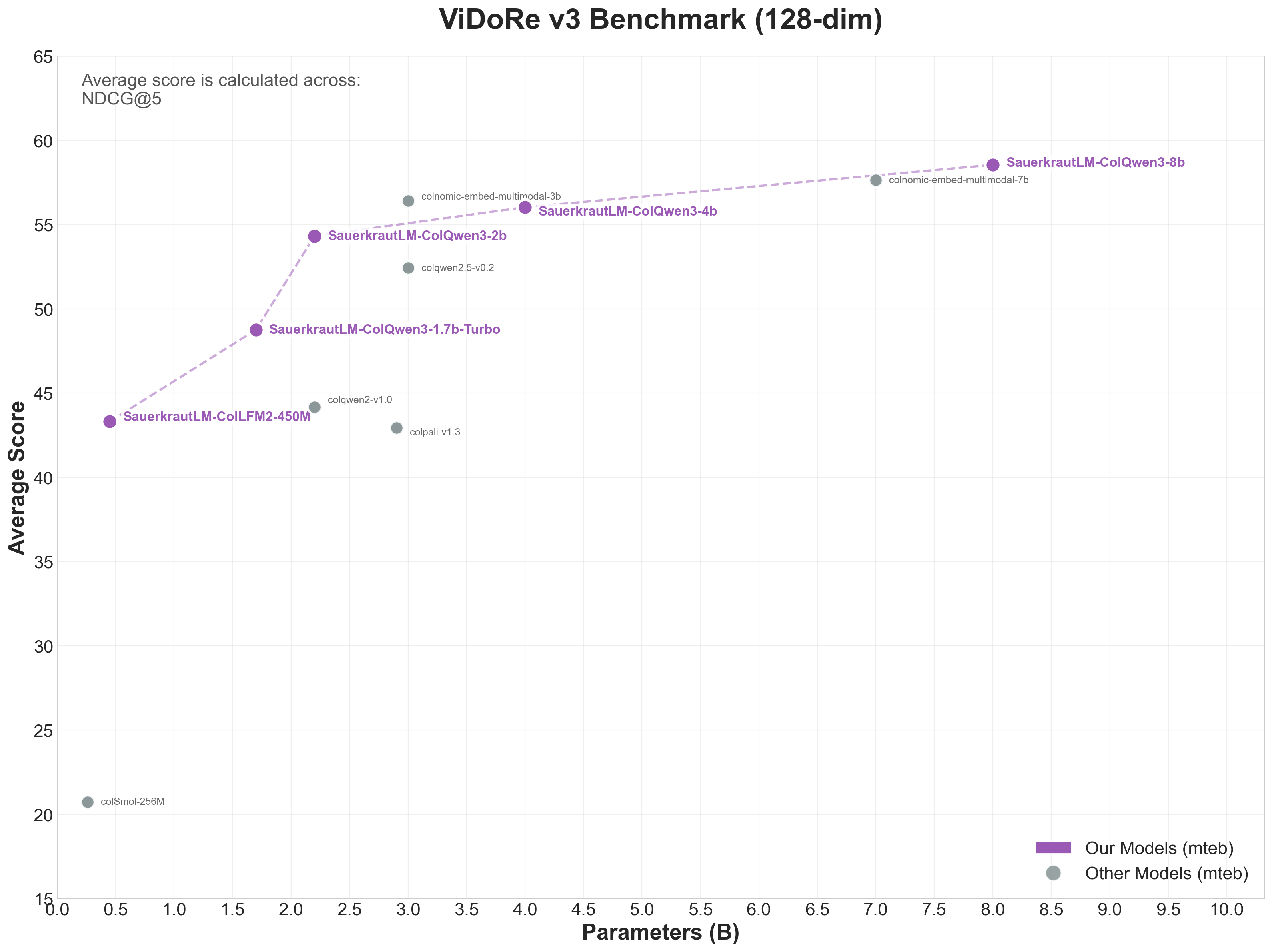
| ViDoRe v3 | 48.76 | #7 |
| Model | Params | Dim | ViDoRe v1 | MTEB v1+v2 | ViDoRe v3 |
|---|---|---|---|---|---|
| SauerkrautLM-ColQwen3-2b-v0.1 ⭐ | 2.2B | 128 | 90.24 | 81.02 | 54.32 |
| colqwen2.5-v0.2 | 2.2B | 128 | 89.54 | 81.12 | 52.44 |
| colqwen2-v1.0 | 2.2B | 128 | 89.23 | 79.74 | 44.18 |
| SauerkrautLM-ColQwen3-1.7b-Turbo-v0.1 | 1.7B | 128 | 88.89 | 77.94 | 48.76 |
| Model | Params | ViDoRe v1 |
|---|---|---|
| ColQwen3-1.7b-Turbo | 1.7B | 88.89 |
| colpali-v1.3 | 2.9B | 84.75 |
| colpali-v1.2 | 2.9B | 83.15 |
| colpali-v1.1 | 2.9B | 81.61 |
Turbo model beats ColPali-v1.3 by +4.14 points with 42% fewer parameters!
| Task | Score |
|---|---|
| ArxivQA | 91.09 |
| DocVQA | 60.98 |
| InfoVQA | 92.08 |
| ShiftProject | 87.76 |
| SyntheticDocQA-AI | 98.16 |
| SyntheticDocQA-Energy | 97.49 |
| SyntheticDocQA-Gov | 94.88 |
| SyntheticDocQA-Health | 98.26 |
| TabFQuAD | 87.03 |
| TATDQA | 81.19 |
| Average | 88.89 |
ViDoRe v1 Tasks:
| Task | Score |
|---|---|
| ArxivQA | 91.09 |
| DocVQA | 60.98 |
| InfoVQA | 92.08 |
| ShiftProject | 87.76 |
| SyntheticDocQA-AI | 98.16 |
| SyntheticDocQA-Energy | 97.49 |
| SyntheticDocQA-Gov | 94.88 |
| SyntheticDocQA-Health | 98.26 |
| TabFQuAD | 87.03 |
| TATDQA | 81.19 |
ViDoRe v2 Tasks (Multilingual):
| Task | Score |
|---|---|
| ViDoRe-v2-2BioMed | 53.92 |
| ViDoRe-v2-2Econ | 47.85 |
| ViDoRe-v2-2ESG-HL | 57.23 |
| ViDoRe-v2-2ESG | 43.27 |
| Combined Average | 77.94 |
| Task | Score |
|---|---|
| ViDoRe-v3-CS | 67.14 |
| ViDoRe-v3-Energy | 56.48 |
| ViDoRe-v3-FinanceEn | 46.17 |
| ViDoRe-v3-FinanceFr | 33.73 |
| ViDoRe-v3-HR | 46.66 |
| ViDoRe-v3-Industry | 39.44 |
| ViDoRe-v3-Pharma | 55.31 |
| ViDoRe-v3-Physics | 45.14 |
| Average | 48.76 |
After pruning, the model underwent recovery training:
Pruned Model → mMARCO Pre-training → Fine-tuning → Final Model
The mMARCO pre-training was crucial to "heal" the model after pruning.
| Property | Value |
|---|---|
| Original Model | Qwen3-VL-2B |
| Parameters | 1.7B (-23%) |
| Embedding Dimension | 128 |
| VRAM (bfloat16) | ~3.4 GB |
| Max Context Length | 262,144 tokens |
| Pruning Method | Layer + Intermediate Size |
| Recovery Dataset | mMARCO |
| License | Apache 2.0 |
| Setting | Value |
|---|---|
| GPUs | 4x NVIDIA RTX 6000 Ada (48GB) |
| Effective Batch Size | 256 |
| Precision | bfloat16 |
⚠️ Important: Install our package first before loading the model:
pip install git+https://github.com/VAGOsolutions/sauerkrautlm-colpali
import torch
from PIL import Image
from sauerkrautlm_colpali.models import ColQwen3, ColQwen3Processor

model_name = "VAGOsolutions/SauerkrautLM-ColQwen3-1.7b-Turbo-v0.1"

model = ColQwen3.from_pretrained(
    model_name,
    torch_dtype=torch.bfloat16,
    attn_implementation="flash_attention_2",
    device_map="cuda:0",
).eval()

processor = ColQwen3Processor.from_pretrained(model_name)

images = [Image.open("document.png")]
queries = ["What is the main topic?"]

batch_images = processor.process_images(images).to(model.device)
batch_queries = processor.process_queries(queries).to(model.device)

with torch.no_grad():
    image_embeddings = model(**batch_images)
    query_embeddings = model(**batch_queries)

scores = processor.score(query_embeddings, image_embeddings)
✅ Choose Turbo when:
❌ Choose 2B instead when:
@misc{sauerkrautlm-colpali-2025,
  title={SauerkrautLM-ColPali: Multi-Vector Vision Retrieval Models},
  author={David Golchinfar},
  organization={VAGO Solutions},
  year={2025},
  url={https://github.com/VAGOsolutions/sauerkrautlm-colpali}
}